Impressive piloting
I don't often submit video to my blog that I didn't create but this was so impressive I had to do it! This helicopter rescue pilot gives new meaning to the concept of 'ground reference maneuver.'
Onwards & Upwards!
Rob Bremmer


I thought it would be fun to list all the aircraft and simulators I've flown. Here is the complete list. The Aeronca Chief was by far the most fun, followed by the Great Lakes. There are memories and stories attached to each, but that can be for a later post.


A friend just got a job in Los Angeles. A dream job - creative, fulfilling - his work will appear in the movies, he knows it, he already knows the title of the film he is working on.


What if there was a store where you could buy parts for your antique aircraft - you know, the one that went off the assembly line over 50 years ago?
Well, there is! and it is called Aircraft Spruce. I never knew they existed until I bought an Aeronca Chief (11AC) in the mid eighties, and decided to install compression tailwheel springs. There is something a little bit like being a kid at Christmas when your package arrives. You may not know this, but as an owner/operator of an official antique aircraft you can make arrangements for supervision with an A&P, which allows you to do the installation work of non-aerodynamic parts (such as tailwheel springs) and then he can certify the work and log the maintenance after he inspects it. It's a good way to really get to know your aircraft and the inspection process too.
Onwards & Upwards!
Rob Bremmer
Helping a struggling student obtain a goal, or helping someone awaken to their potential, is always a good thing! Here's how you can help.
I've set up a donation link. Donate anything, even a dollar. When a significant amount is reached, and I figure $1,000 is a reasonable threshold, I'll make a donation to help some student obtain a flying goal.
I am motivated when I think of how hard it was for me to obtain flight hours, equipment, books, training - every aspect of flying had a cost and it was not easy to do it. It took me a long time, and I had no assistance. There were people I met who could've have benefited even more than I, from assistance and I'd like to help some of those students. I'd also like to help awaken young people from difficult backgrounds to the wonders of flight, and the experience of learning to control an aircraft, and observing your world from a new perspective.
While the account is growing, I'll be looking for the best way to help a student or young person, and I am open to suggestions from you, the reader. I am particularly looking forward to reporting the results - how we have together actually made a difference. Let's see what type of a difference we can make!
Onwards & Upwards,
Rob Bremmer

 First, look at the springs. The illustration shows compression springs installed, and typical tension springs not installed but next to the compression springs for comparison. You should use compression springs, for several reasons. Compression springs in their unactivated state, or when the rudder is neutral, are not applying any force on the tailwheel. They only apply force when the rudder is moved left or right, and then only on the side of desired movement. Tension springs, on the other hand, apply tension all the time, so if one breaks, (and tension springs are typically more inclined to occasionally break) the broken side whips free and the tension on the other side pulls the tailwheel to the side. Not good at critical points of a landing or while taxiing! Compression springs also give better handling. When you are taxiing with a tension spring, and you push rudder, it stretches the spring and the wheel thinks about moving then responds, in a springy sort of way. When you do the same with compression springs, the response is tight and immediate, which means as pilot and operator, you get immediate feedback as to whether you need more or less rudder input; you don't have to wait and see what will happen. Also, compression springs are typically thicker. Thicker metal outlasts thinner metal every time.
 It's New Year's Eve!
Let's put down serious talk about flight, reminiscing and everything else and play a few games. I've embedded a fun little game gadget at the bottom of the blog, and here are a few links to other online flying games.
Airfox Squadron Angel A quick fun game of Helicopter, A site for Many free flying games A site to Demo games before purchase and this site is good for kids of all ages. Enjoy!
Onwards & Upwards!
Rob Bremmer

Small aircraft can be greener, more eco-friendly and sustainable than cars! Here’s the argument for the case.
Just out of curiosity, why don’t more environmentalists support flying? Especially flying small general aviation planes. Think about it. A four seat aircraft weighs less than a four seat car and less materials are used. An aircraft going from point A to B will get there faster, therefore the engine and systems run for less time than a car over the same distance. While we are on point A and B, a car travels a squiggly circuitous route to get from A to B while a plane can fly relatively straight, so the plane travels less distance to get there. Airplanes travel in three dimensions while a car travels in two, so aircraft can distribute congestion over altitude. Let’s compare fuel consumption over the trip and see how that works out. We’ll compare and contrast a car and a plane over two distances, 100 miles and 1000 miles.
Plane:
Miles traveled : 100 1000
Speed: 120mph 120mph
Time traveled: 50min (.833h) 8h30min (8.5h)
Fuel consumption @ 6gph: 5gal 50 gal
Car:
Miles traveled : 100 1000
Speed: 65mph 65mph
Time traveled: 1h32min (1.53h) 15h20min (15.38h)
Fuel consumption @ 20mpg: 5gal 50 gal
As you can see, the fuel consumption is the same yet the time traveled is much less for the aircraft. There are other benefits too; including wear and tear on the two vehicles, which will be less for the aircraft over the same distance. There is just less friction in play to wear down the aircraft than there is friction wearing down the ground vehicle.
Now the naysayers can quibble over all this. Some will say the fuel consumption is off, and will create a scenario to prove that. Others will say the cost of production is off, or there are fewer landing places which is true, but this is more a factor of aircraft design and zoning rather than anything else. Yet any argument the naysayers construct will be dwarfed by the one, elephant-sized issue, always overlooked, which is in the favor of the aircraft; the car needs 1,000 miles of highway built and maintained while the airplane needs only 1 mile for the same 1,000 mile flight, with a half mile for take-off and a half mile for the landing.
Let’s just say, conservatively, that it costs $10,000 dollars per mile of runway or finished highway. So our mile of runway costs $10,000 while the highway would cost $10,000,000. And this does not even include the environmental destruction which occurs with those extra 999 miles of highway!
So why aren’t more people flying and saving time and the environment? That’s a good question! In today’s environment; costs, legal, cultural and bureaucratic blocks, thwart progress and growth, but the good news is none of these are insurmountable.
If you love aviation and you care about the environment, we ought to start advancing discussion on this and similar arguments. It is possible, with design enhancements within existing technology to make aircraft more flexible for use. Zoning changes can make airports more practical to build and maintain. Improved aircraft design using known technology and design can improve aircraft performance for airport operations. Training changes can make pilot proficiency better, marketing can increase the value of general aviation in the public eye and political strength can help fight for better utilization of general aviation. If you are interested, you can help start the dialog needed to begin making the changes.
onwards and upwards!
Rob Bremmer
This is a response to the comments posted earlier. It seems there is a lot of interest in this subject! Besides setting a low ASA, (which reduces the graininess) you want to get the best f stop at the highest shutter speed. I find any shutter speed ove 250th of a second guarantees I'll get rid of any vibrations (higher speeds are better in turbulence) and then I set the f stop for the smallest aperture possible without driving the shutter speed lower. As for focus, my camera, a mid - level Canon digital SLR style camera, will usually work fine on auto focus, but if it does not I set it to manual and set it to infinity.Hopefully the sun angle is low, like you would get from sunrise to around 10 am or 3 pm to sunset. The lower the angle, the more dramatic the shot as their will be more color possibilities and better contrast from shadow detail. Alas, we cannot always choose our flight for the sun angle!Your goal is to get the target image in or near the center of the image, with no parts of the airplane in sight. Try to shoot through clear sections of class if your window is smudgy, and if it is smudgy on the inside, you may be able to clean it a bit with a blanket or cloth. Yet capturing the image i just half the story. Think of it as capturing the 'raw data.' When you bring the image up on you computer, it will typically have a bluish sheen from reflectivity and shooting through the Plexiglas. If the details on the ground are strong enough you can significantly or even completely 'tune out' this image problem by increasing the brightness and contrast in even the most basic photo editor. The Google Picasa editor (free download) can do this for you, or you can use the Microsoft Photo edit suite, which I also use. The three areas I usually use to tweak a photo and dial out the glare are contrast, brightness and color temperature. Sometimes I sharpen the image with focus, if necessary. I hope that helps! If anyone gets an interesting shot they would like to share, email me at rob.bremmer@gmail.com and I'll post your photo and give you photo credits.
onwards and upwards!
Rob Bremmer


Aerials on a Friday afternoon in summer are good ~ Aerials of an active volcano are better!
Part of the fun of taking aerial photographs is introducing a friend to the fun of it. Recently I flew a friend around Mt. St. Helens. These photos were taken by Michael R, his first aerial photos, taken from a C-172 open window. The contrast was increased slightly and brightness decreased slightly in Photo edit suite.
The flight was an hour and a half round trip, with 25 minutes lingering on-station, circling the remnant mountain top. The most dramatic images were shooting towards the sun with the dark foreground and colorful background and shooting east, with the wall of the crater illuminated by the setting sun and revealing the mineral complexities on it's slope, along with some ash and sheets of ice. There was no turbulence during the flight, which made for a more stable shooting platform.
onwards and upwards!
Rob Bremmer
How to make aerial photos from the window of an airliner 'more better.'
This is a response to the comments posted earlier. It seems there is a lot of interest in this subject! Besides setting a low ASA, (which reduces the graininess) you want to get the best f stop at the highest shutter speed. I find any shutter speed over 250th of a second guarantees I'll get rid of any vibrations (higher speeds are better in turbulence) and then I set the f stop for the smallest aperture possible without driving the shutter speed lower. As for focus, my camera, a mid - level Canon digital SLR style camera, will usually work fine on auto focus, but if it does not I set it to manual and set it to infinity.Hopefully the sun angle is low, like you would get from sunrise to around 10 am or 3 pm to sunset. The lower the angle, the more dramatic the shot as their will be more color possibilities and better contrast from shadow detail. Alas, we cannot always choose our flight for the sun angle!Your goal is to get the target image in or near the center of the image, with no parts of the airplane in sight. Try to shoot through clear sections of class if your window is smudgy, and if it is smudgy on the inside, you may be able to clean it a bit with a blanket or cloth. Yet capturing the image i just half the story. Think of it as capturing the 'raw data.' When you bring the image up on you computer, it will typically have a bluish sheen from reflectivity and shooting through the Plexiglas. If the details on the ground are strong enough you can significantly or even completley 'tune out' this image problem by increasing the brightness and contrast in even the most basic photo editor. The Google Picasa editor (free download) can do this for you, or you can use the Microsoft Photo edit suite, which I also use. The three ares I usually use to tweak a photo and dial out the glare are contrast, brightness and color temperature. Sometimes I sharpen the image with focus, if necessary. I hope that helps! If anyone gets an interesting shot they would like to share, email me at rob.bremmer@gmail.com and I'll post your photo an give you photo credits. I hope ths helps those who are interested.
onwards and upwards!
Rob Bremmer


You might think you need a small plane or a big budget to take interesting aerial photographs but that isn't true! Photos taken from the seat of any airliner, with a little planning, can yield spectacular results.
These photos of Crater Lake were taken from a right-side passenger window seat in front of the wing of a Horizon Air RJ Regional Jet on a flight from Southern California to the Pacific Northwest. It does require a little planning ahead to capture such shots, for example, having a window seat is very helpful, and a clean window is important too! You also want to sit in front of the wing, as far in front as possible to maximize opportunities to see the ground. Behind the wing can be interesting, but the wing will limit your view forward and if the aircraft has wing mounted engines the thrust and exhaust gases will distort the air, ruining a clean view of any object on the ground. Sitting over the wing renders ground shots useless, but interesting cloud shots can still be obtained!
Any digital camera will work, but the better ones allow you to set a lower ASA number and maximize the quality of the photo in terms of photo size which equates to more megabytes per image. A zoom lens is helpful but not necessary. Sometimes a wide angle will give more interesting shots encompassing sky and land, yet a telephoto, while allowing the appearance of closeups, can highlight haze in the atmosphere and is more inclined to pick up shaky vibrations which blur the shot.
Don't conserve shots! Shoot like crazy; it's digital, so after the opportunity has passed by the window, you can edit away the weaker images. Remember you are traveling at over 200 miles per hour so when you see look as far ahead of the plane as you can and when you see something that looks interesting get your camera ready and start taking pictures!
I could mention that while I was taking these images I was being served complimentary chilled northwest micro-brews, a unique and classy service on the last remaining civilized airline in the United States, but that would be an entirely different story!
onwards and upwards!
Rob Bremmer
I've added a small survey to uncover the predominant reason people don't fly as much as they could.Please take the survey, and check back later for the results.
onward and upward!
~ rob bremmer


As the old song suggests, the visual beauty of clouds may be appreciated from the top looking down as well as the more traditional bottom looking up. This post is in honor of John Day, a physicist who recently passed away, and spent his life studying clouds and promoting cloud watching. I feel certain he would have enjoyed flying, leaning out an open airplane window and taking photographs of clouds from the top to compliment the view from the ground.
I only just learned of Dr. Day and his work recently. He studied clouds, wrote about clouds and cloud physics, turned cloud photos into art and even got the US Postal service to put one of his cloud photos on a postage stamp.
Knowing this I am convinced I would have enjoyed talking to the man and I believe he would have enjoyed discussing and comparing images and stories about clouds. As a pilot, I've always watched clouds and whenever possible, taken photos from an airliner window as well as open cockpit and open window small planes. Clouds can be just as fascinating when viewed from the top looking down, as they can be from the bottom looking up!
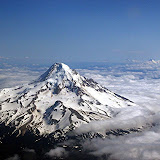
The three photos here are my favorite cloud images recently shot. The orange mammatus cloud shapes were at Sunriver after a thunderstorm. The striation lines of clouds cast interesting shadows over the Bitterroot mountain range while flying east, and Mount Hood makes an early summer roadblock for a mid-level line of stratus, forced to curve around the shape of the mountain.
You can view Dr. Day's images and read more about him and his work on his website, at www.cloudman.com.
onwards and upwards,
Rob Bremmer

7-4-08
America is unique in many ways and certainly one of the most special and precious is the freedom to fly. As I think back over the years of flying aircraft I can recall a few flights taken on the 4th of July and I can recall the surge of feeling which arises when flying and seeing fireworks displays. One memory stands clearer than all the others.
It was the mid 1980’s and I was flying from San Diego north through the LA basin. The plane was a Grumman Tiger, an AA-5B, an aircraft with exceptional visibility through the bubble windscreen and the side windows, despite the low wing which often can block a view. The day was warm and the departure from Gillespie field was just after sunset, which put us inside the Los Angeles basin well after dark. We were flying low and wide, to skirt the Class B Airspace (A TCA to those of you who flew with the older designations). Flying under the shoulder of a controlled airspace is best accomplished by charting a distant landmark and a nearer landmark that create a line clear of the controlled area, So that you can keep your eyes outside the cockpit and just concentrate on holding your altitude and enjoying the view as you stay on track on your courseline.
This technique frees you to keep a maximum lookout for other traffic, which is easier to see at night than in the daytime since you need only look for anti-collision, landing, and navigational lights. This also means your eyes are drawn quickly to assess moving lights, and on this evening, with clear nighttime air, fireworks displays popped out in stark contrast to the black hills to the east of the valley.
The effect of seeing the displays all around us, in front, to the rear quadrants and to the sides both near and far was inspirational. My passenger and I were Americans, flying an aircraft on our own, in free and clear skies and seeing the celebration of that national freedom surrounding us with dazzling and sparkling displays of lights, bursting and shimmering like rapidly blooming and fading flowers of brilliant light.
Soon we were through the valley and on into the darkness of the terrain enroute to San Luis Obispo. The radio chatter was nearly gone and the sights to look at were nearly non-existent, so much so we were using the instruments as much as outside reference to aid our VFR flight into the black night. Above us the stars filled the sky and my only thought for a while was the good fortune I held as pilot controlling an aircraft in flight.
The instrument panel glowed with a warm red light and the white wings caught the alternating flash of the anti-collision light from the top of the vertical stabilizer. A deep breath in and a long gentle exhale while I soaked in the scene around me. My wish was that others might be able to feel the sense of incredible satisfaction, joy and a calm resolute peace which comes at such a moment, a moment I am certain occurs more often for pilots than anyone else on earth.
onward & upwards!
r. bremmer


 Posts
All Comments
Posts
All Comments


 Posts
All Comments
Posts
All Comments